Bridging the gap between atomistic detail and continuum mechanics is a central challenge in modeling biological membranes, particularly for mesoscopic phenomena spanning large length and time scales. MesoMem is a solvent-free, one-particle-thick coarse-grained model for lipid bilayers governed by an additive potential that treats orientational elasticity through distinct tilt and splay energy terms. The model is implemented as a custom pair-style in the LAMMPS molecular dynamics engine and is freely available.
Key Features
Additive Potential
Orientational elasticity is split into independent tilt and splay energy terms, offering an unbiased potential form and direct physical interpretation of each contribution to membrane mechanics.
Mesoscale Efficiency
Each particle represents a bilayer patch of ~300 lipids. The model accesses microsecond timescales and micron-scale membrane areas — far beyond what atomistic or standard coarse-grained models can reach.
LAMMPS Implementation
Implemented as a custom pair-style in LAMMPS, with full support for MPI parallelization. The source code, example scripts, and tutorials are openly available on GitLab.
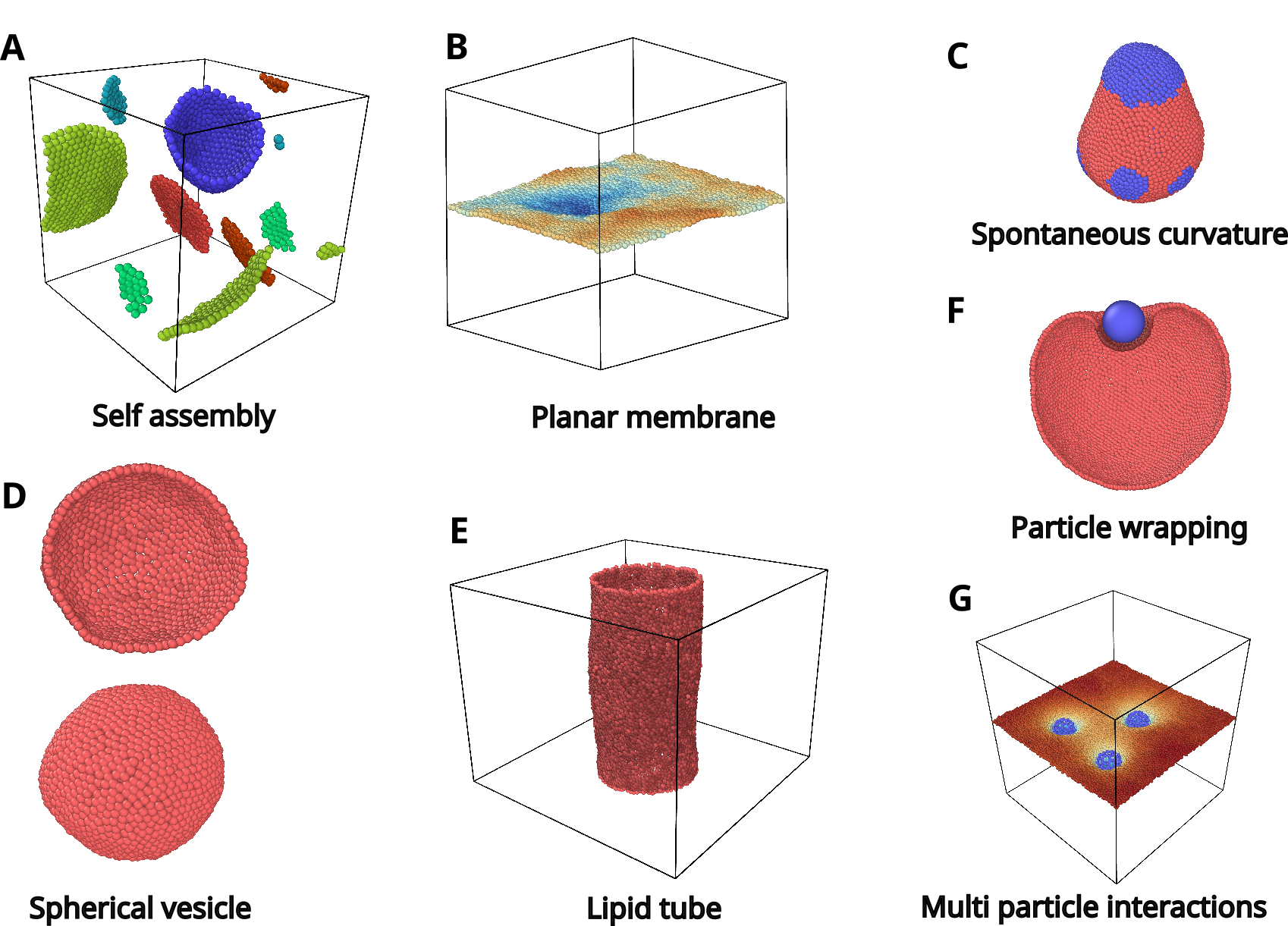
Overview of Simulated Systems
Capabilities
Self-Assembly & Vesiculation
Particles spontaneously assemble into lamellar structures and close into stable vesicles from a disordered state.
Tunable Mechanics
Bending rigidities in the biologically relevant range of 10–30 kBT and area compressibility moduli calibratable to experimental values.
Rich Extensions
Supports spontaneous curvature, multiple lipid types, and adhesive interactions with colloidal nanoparticles. Osmotic pressure can be applied to vesicles by adding explicit solvent particles inside and outside, while the membrane model itself stays solvent-free.
Tutorials
Step-by-step tutorials on planar membranes and vesicles are coming soon.
Citation
If you use MesoMem in your research, please cite:
P. Sillano, S. J. Marrink, and T. Idema, MesoMem: A mesoscale membrane model based on an additive potential, Phys. Rev. E 114, 034412 (2026). https://doi.org/10.1103/4dhv-8xd7
@article{4dhv-8xd7,
  title = {MesoMem: A mesoscale membrane model based on an additive potential},
  author = {Sillano, Pietro and Marrink, Siewert J. and Idema, Timon},
  journal = {Phys. Rev. E},
  volume = {114},
  issue = {3},
  pages = {034412},
  numpages = {11},
  year = {2026},
  month = {Sep},
  publisher = {American Physical Society},
  doi = {10.1103/4dhv-8xd7},
  url = {https://link.aps.org/doi/10.1103/4dhv-8xd7}
}
